
Our team has published a scoping review that consolidates how eye-tracking has been used to evaluate the usability of interactive geovisualisations (interactive maps). The study responds to an important gap: despite rapid growth in interactive mapping, the field has lacked a structured, reproducible overview focused specifically on usability evaluation in interactive settings.
Following the PRISMA-ScR framework, we carried out a systematic search in Web of Science, Scopus, and the ACM Digital Library, covering publications from 2005 to early 2025. From 727 records, 685 unique entries were screened after removing duplicates, and 87 studies met all eligibility criteria for synthesis. The review maps the evidence across key dimensions, including evaluated visualisation types, task categories, participant characteristics, study designs, and applied eye-tracking metrics.
Key findings show that research still concentrates mainly on interactive 2D maps, with strong dominance of fixation-based approaches (e.g., fixation counts/durations, scanpaths, AOIs, time-to-first-fixation) and frequent use of heatmaps. At the same time, the literature repeatedly reports methodological challenges linked to dynamic content (changing map states), scale and zoom variability, and limited ecological validity (overreliance on laboratory conditions). Many studies also rely on small, demographically homogeneous samples, while standardised usability instruments (e.g., SUS, NASA-TLX, UEQ) remain underused.
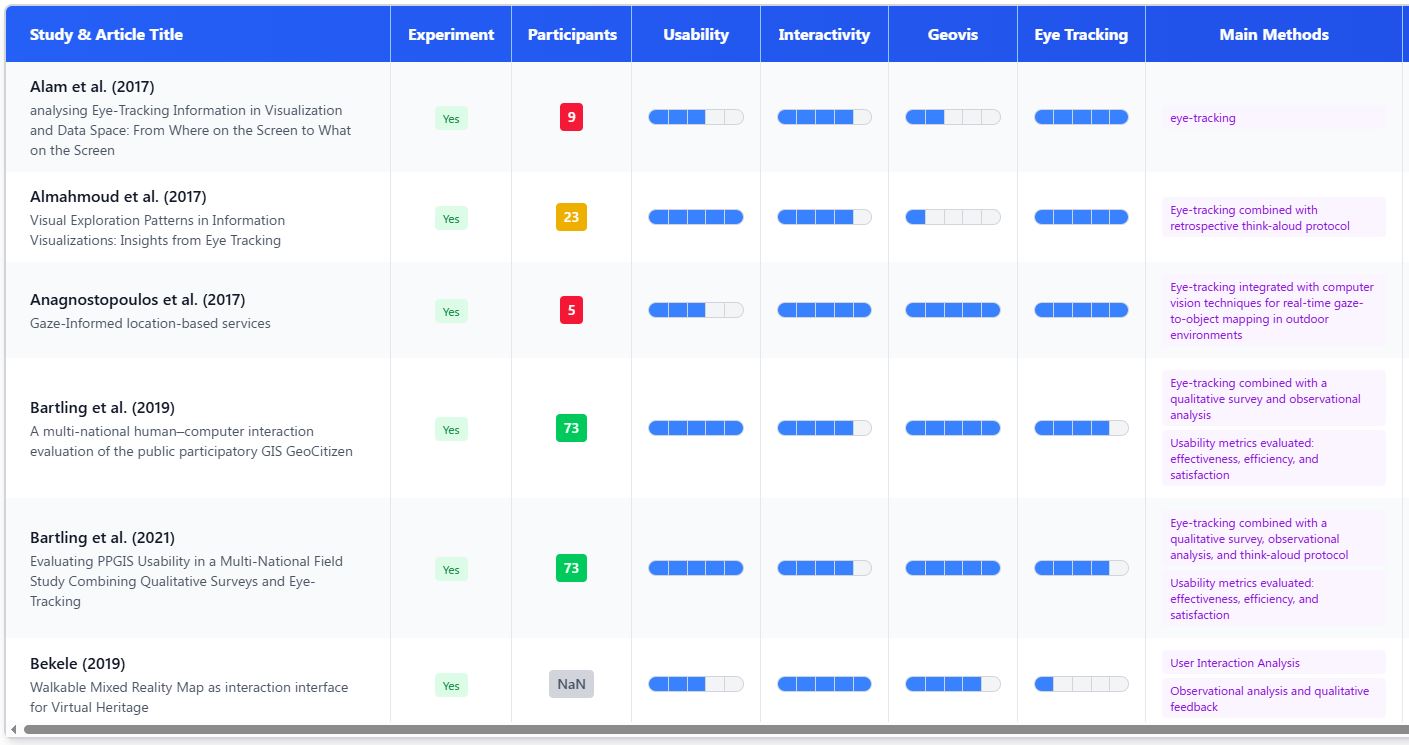
To make the outcomes practically usable for researchers and practitioners, the paper also provides a web-based interactive overview table summarising all 87 included studies, enabling filtering by topic relevance, methods, tasks, and participant information. The review concludes with targeted recommendations aimed at improving comparability and robustness in future studies—particularly through greater diversity of stimuli (including mobile, field, and immersive contexts), more advanced analytical approaches for interactive content, stronger multimodal triangulation, and more inclusive participant sampling.
You can read the paper “A Scoping Review of Eye-Tracking Studies on the Usability Evaluation of Interactive Geovisualisations” published in the International Journal of Human-Computer Interaction.